


Communication Training based on bio-mimicry for better decisions

Updated: Aug 18
Do you wish you knew how to get your company or team to make better decisions on more complex topics?
Are you familiar with the 'paradoxes' of complex decision-making?
Paradoxes of complex decision-making
Complex decision by committee can be a problem often leading to 'weird Frankenstein solutions'.
Thinking one person could decide everything is another option, but no one person knows all the important information.
Wishing it was a 'closed-world' situation in which we've already agreed on all the major decisions and just have to optimise within that context (just control costs/execution for known value), yet it's an 'open-world', and we also need to agree the context and scope too, and this changes the upper limit of the value of what we produce, a much bigger decision, with more uncertainty in how to decide.
Wishing we can just use facts and don't need to worry about other kinds of information product, such as some imaginative possibilities, 2nd order effects, etc..
Wishing we could just make imperfect decisions and have them fixed later on by changing the things we've done and built ('agile' solutions), but those solutions are not really 'agile' enough to avoid costly mistakes in the beginning.
If you recognise these 'paradoxes' then this training in communication strategies is for you.

Complex Decision-Making & communication strategies
Simple decision-making can be defined as where the output is a simple 'information product' like a binary 'Go/No-Go', or 'Yes/No' decision or a simple choice from a set of pre-selected options, such as Option A, Option B, Option C, Option D.
In contrast, complex decision-making is where the output is of a whole series of decisions that need to work together, producing a far more complex output than a binary choice or single element from a pre-defined set. The output is then a complex information product, such as an architecture, some temporal plan, or a complex report, such as a business strategy.
Key insight of bio-mimicry, we can learn from Nature
The main insight from Turing Meta is that needing to make lots of decisions based on information exchanged between lots of people turn this into a communication theory problem with communication strategies that can solve this analogous to how cells communicate in your body via biochemical signalling and 'signal transduction' in general, (see References).
There is plenty of empirical research into how these more complex decisions can be more effectively made in companies, but this is mainly based on existing examples that have already been tried. One of the most sophisticated treatments in the literature is due to Elinor Ostrom in the context of the problem of managing resources (See References). Uniquely, however, Turing Meta is also up-to-date with cutting-edge research in biological systems concerning how organisms adapt to integrate information to produce such complex 'products' as 'us', enabling your business to learn from solutions empirically proven in biological systems, to solve similar problems.
The key concept to understand how to leverage this science, is 'complex communication inertia'.
Complex communication inertia
Lots of informal relationships and organisational structure biases can reduce the quality of complex information products. This is because they introduce inertia into how communication happens within the decision process, due to the (very rational, and important) need to conserve and protect established relationships. This however, means they introduce a complex form of communication inertia where we either copy and accept or reject suggestions wholesale from one another, because it is cheaper and easier, or because there is an organisational structure or informal relationship that we need to maintain or build further. In committees, the opposite happens, and we are unable to accept or reject suggestions wholesale, and must modify the suggestion instead.
Crucially, this problem is also seen in biology (See Technical References) and has little to do with psychology, as it also affects cells, and even genes.
Turing Meta's unique training simplifies complex biological theory to learn and specifically target complex communication inertia that reduces how fitted the decisions are to the context. This training is based on your specific organisational structure and relationships. The bias you have in communication depends completely on your existing organisation, and so the correction to communication strategies needs to reflect what your organisational structure is.
The result of correcting this organisation bias, is ultimately to increase the precision of your collective decisions, producing better fitted complex information products to your actual challenges, as a business.
In other words, the training teaches teams to communicate in ways that achieve higher quality collective decision outputs, just as this works empirically, in biology, but tailored to your specific organisation, because otherwise, it simply wouldn't work, or would have the opposite effect. Here is a simple analogy used in the training workshops:
The 'pizza slice' analogy
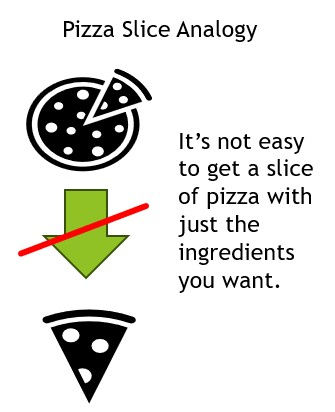
An analogy for communication is the analogy of being offered a slice of pizza. When someone communicates some idea to you, you have to decide whether to accept it or reject it, just as you can decide whether to accept the pizza slice offered to your or not. Obviously, in the analogy, whether you accept it, depends on whether you like that particular type of pizza. In the decision process, that pizza represents a suggestion and your options relate to what you think about the quality of someone's suggestion.
But, of course, there is a third option: It's like if someone decides to buy a pizza without your initial input. You can take a slice, or not, but the third option is to take the slice and first remove the ingredients you don't like by hand.
This 'pickiness' is more work, but is often the key to making the 'product' more fitting to your needs or, in general, making any product more fitted to its actual needs.
Depending on the existing organisation and structure, one of the first two choices are cheap and easy, and make it easier for everyone to get along. If you are in a subordinate position you more easily accept the suggestion as it is, as it's hard to reject a suggestion from a superior in the organisation. If you are in a position of authority it is also easy to reject it politely, and move on, and the more the decision is outside the main flow of ideas, the easier it is to reject it, rather than accept it.
The third option to modify the pizza slice is usually always more expensive and time-consuming than the easiest option of just taking the slice as it is, or not taking the slice at all, given the existing. But, in committees this can be the default easiest option, instead. This is because often no suggestion made by someone survives from not being modified by the committee.
So, depending on the organisation, at least one option leads to higher friction and complexity than others, a clear bias in the working of the organisation. But, the availability of all three of these options, are, it turns out, an essential strategy for more complex decisions when we share information and suggestions with each other.
There are many complex reasons why we don't use all three options equally as often as we could or should, just as it makes biological systems more complex when they use a similar organisational strategy to solve a complex challenge.
Like if you think of a simple mechanism, when I switch on the light, I always expect it to work, or if the bulb is gone, it doesn't and then I can simply choose whether to replace it. I don't expect it to 'half work', or choose when to work, and when not to. But this is more how biological systems work, precisely so that information is more precisely used. On the other hand, there are contexts where the opposite is the case, and the biological system resists all and any changes or modification. This availability of all options in what information to accept requires more complex communication strategies to correct for biases, and so is a challenge.
The futility of changing the organisation
If you try to correct for bias against one option you can change the organisation to bias for another option, but then you simply have the opposite bias problem. The bias in not being able to reject pizzas from one person, is shifted by the change in organisation to a bias in not being able to offer pizzas to someone else. Or a change to the organisation means the pizza always has to be modified, no-one can accept the pizza the way it is, when sometimes that is what a complex solution requires.
Complex decision products suffer from any of these biases, not from one or either. That is why there is such futility in blaming the organisational structure, and why technically, it is also correct to blame the organisational structure. It's just, that changing the organisational is not the solution. Elinor Ostrom modelled these complex decision products in relation to nature conservation and found that very complex organisations result due to these complex demands, but that empirical work and analysis of human organisation doesn't give us an incisive theory of how to understand and apply solutions effectively. This is why leveraging biological theory in the right way can take us in a new direction, with far more clarity and incisiveness.
To be clear agility in the decision stage is not primarily, about speed of decision-making but about the 'choosiness' and agility in that sense, which avoids producing simple combinations of opinions and associated biases due to complex communication inertia.
The solution is to reduce the inertia so that we respond more to the value of information and less to the structure of the organisation.
The value of information is a far more fine-grained thing than the value of any given organisational structure. That is why changing the communication strategy is not equivalent to changing the organisation. And a simple example of how this works comes from the history of audio recording and the analogue tape:
An audio tape engineering analogy - putting the 'agility' in the right place
A useful engineering analogy comes from the days of audio tape recording and mastering in sound studios. In the 1950s, analogue magnetic tapes used to be bad at recording audio, because the magnetic layer on the tape that responds to the signal has high inertia. That meant they would record an electronic sound wave signal, but not form the exact wave of the audio signal very well, because they were too slow to change shape quickly enough as the tape was running. What's interesting is that the magnetic layer on the tapes still has high inertia today, but they have been used as high quality master tapes of audio in top recording studios for decades. If their inertia didn't reduce, how did they change to to recording audio signals, so well?
The story is, one day, an audio engineer, purely accidentally, added an extra very high frequency sound when recording some audio onto a tape. The engineer then noticed that this particular tape recording sounded great. Why?
The very high frequency sound (at about 50Khz) was outside human hearing, but made the magnetic layer on the tape move around very fast (because a high frequency signal) which then reduced the inertia for all other signals being recorded as the same time.
The actual intended sound recorded at the normal frequencies was then recorded with much higher fidelity, because the inertia of the magnetic metal layer of the tape was much lower due to the magnetic layer 'dancing around' very quickly due to the high frequency signal it was moving to, at the same time*.
Reducing complex communication inertia by adding bias
Just as with the tape, the key to reducing complex communication inertia is therefore; you don't modify your existing organisation structure to remove the complex inertia that comes with whatever your existing organisation structure, whatever it is, that's not possible. Every organisational structure, whatever it is always has inertia corresponding to the communication channels that are preferred. However, what signal is being used (communication strategy) within the organisation, can be used to bias the way information flows to add the agility to the process, which ends up being the 'choosiness' within the system, raising the quality of choices above the default inertial level to better reflect the true value of the information communicated (good or bad).
Therefore, whatever organisational structure you have, or use, primarily there are different biases. The solution is to add communication strategies on top of the organisation which address the particular biases of the organisational structure you've chosen.
These communication strategies change how you communicate, rather than fundamentally change the organisation structure. Just like adding a specific bias in the signal recorded to the audio tape, rather than changing the tape itself, to correct for the inertia.**
Put agility in the right place II, not mainly in the technology products
It's a kind of 'agility' to be able to overcome the inertia of the default basic choices, and create three real choices for each suggestion. But, putting the agility in using the communication strategy is very powerful, and means that you can end up with far higher quality decisions, and higher quality results than trying to change the whole organisational structure which just changes the bias, rather than removing it. Another option tried, however, is to try to mainly try to put the agility into the product or technology being built off the back of decisions.
Currently, we often try to mainly put the agility in the product itself, as in the case of software programming tooling and processes. This is so that, if we make bad decisions, we can always undo them later. But the technology will always have higher costs to change things than when communicating at the planning stage. By trying to put the agility 'downstream' you are always less agile and less responsive to problems than you are at the upstream communication stage of any decision output.
This communication bias method reduces the complex inertia affecting the quality of your decisions at the point where that extra agility makes the most difference and has the most leverage, which is the decision-making process. This is the opposite of the idea often highlighted in agile systems, where we make very much imperfect decisions and just build things, and hope that the product and process that we built has enough agility to make up for the changes we need to make to it, so we can make later corrections to it, iteratively.
Summary
Uniquely, Turing Meta uses years of work to be able to efficiently and skilfully translate complex theoretical biology into simple business focused training in the theory of what the difficulty and solutions to complex decision-making look like, and how we can learn from natural solutions, just as we learn from Nature to discover new drugs, or new solutions (e.g. Velcro, see References).
The training and workshops cover communication changes to produce more complex information products than management traditionally see, beyond their Yes/No, or choose from options A, B or C type decision outputs. Especially, how to do this collaboratively, in any organisational structure. The training is tailored to your existing structures rather than trying to change them, which is futile and a flawed strategy.
Contact adam@turingmeta.org to start on the path to making complex decisions of higher quality.
(*Incidentally, this added very high frequency sound or 'ultrasound' is the 'bias' that old tape decks had a 'bias' button to remove with an electronic filter, it was just to solve the problem of recording, it wasn't a problem for playback).
(**This is actually just like different biases were added to tapes depending what the type of tape, e.g. 'chrome', 'metal', 'normal', etc as different frequencies worked better for different types of magnetic layer).
References
Invention of Velcro - Wikipedia, see History section
Technical References
Biochemical signalling and signal transduction between cells
Technical explanation of signal transduction, communication between cells:
Turing Meta published on this research in the 2025 book 'On the Origin of Risk', developing the key theory of 'organisation games'. The book is available on this website, other articles on this website explain key concepts, and recorded YouTube talks are also available online.
Biological examples of communication inertia and methods to overcome it
Note: These are all highly technical subjects, but the training translates this into concrete business examples and clear, simple analogies.
These examples all occur at the gene level in various ways, either gene translation and reading, or population genetics, or inter-species information transfer.
Linkage disequilibrium Linkage disequilibrium - Wikipedia
Introns/Exons. Intron - Wikipedia
Horizontal gene transfer Horizontal gene transfer - Wikipedia


