top of page


Subscribe
Search


A unique growth strategy leveraging biological science
Leverage unique analysis for a successful growth strategy based on biological science and biology-inspired maths Turing Meta offers a unique consultancy offering to help your established company continue to grow on limited revenues and new investment. This is achieved by learning how to manage risk the way organisms do in the natural world, leveraging cutting-edge analysis of biological systems. Background idea Animals possess a central nervous system which they use to manage

Adam Timlett
Jun 176 min read


Entrepreneurship & risk management
Between 40-90% of innovation products & services fail*. Reject mainstream venture capital financing theory and practices which has failed to change this. To raise the odds of success you need instead to: Learn from cutting-edge biology how to manage risk as an entrepreneur or an investor by raising adaptive capacity of your start-up or scale up in this specially tailored workshop. Learn cutting-edge risk management by raising adaptive capacity using biology & mathematics Guid
Adam Timlett
Jun 112 min read


Systems in Nature. Why they have higher plasticity & innovative capacity, why efficiency is an organisational tuning parameter
Stance Sketch, James Robert White www.jamesrobertwhiteart.com Download timestamped PDF for citation Managing risk, both opportunity and adversity is about optimising for both for what you can produce now, and what the future may require, and this can look messy. In biology, this is about producing the optimal mixture of both finished products, and also optimising their parts for use in different future products the organism may expect to need. In a sense, this is similar to a
Adam Timlett
May 145 min read


The Mind as the Outcome of a Cryptographically Encoded Brain
Timestamped PDF for download and citation: Untitled, James Robert White www.jamesrobertwhiteart.com Introduction In this article I will present several different pieces of evidence that point towards the idea that the human mind is the product of the brain encoding information cryptographically . I will argue that this means that cryptographic capacity is synonymous with extreme algorithm flexibility . In other words, the cryptographic encoding of an algorithm is also just a
Adam Timlett
Jan 1126 min read
The Productive Pigeonhole Principle: An Answer to Searle’s Chinese Room
PDF with timestamp certificate for download and citation. Introduction Searle’s Chinese Room is a thought experiment which is supposed to prime our intuition against the possibility that the brain is simply some type of computer. It has a long history. First published in 1980, it came to my awareness only in the 1990s, when it was then mainly being discussed in the context of progress in things like early neural networks and whether such ‘sub-symbolic’ architectures made Sear
Adam Timlett
Dec 26, 202538 min read
Type Redundancy & Risk in Biology
This post is to provide access to a PDF which summarises a presentation I recently gave to the the Rationality Vienna group. I really enjoyed the discussion afterwards, and the opportunity to present the latest version of my ideas and work. In the presentation is a, hopefully, intuitive summary of the ideas that biological systems manage risk differently, and I also delve more into the relationship between this and computer theory. Specifically, I look at much more detail int
Adam Timlett
Dec 6, 20251 min read
Label Theory & the Value of Cross-talk
This post is to present access to a PDF describing a theory related to meta-modularity, my main argument for how risk is managed in biological systems. Label theory is a way to understand intuitively the potential value of 'cross-talk' in a system. The signalling systems and the gene regulatory systems in biological systems like the cells and the cell signalling in the human organism are full of cross-talk. This is the process whereby one signalling system interacts with a s
Adam Timlett
Dec 6, 20252 min read


Options beyond Growth and Failure
Timestamped PDF for download and citation In The 2nd Invisible Hand I argued that Nature may be exploiting other options around growth to control problems such as pollution and exhaustion of resources from over-exploitation. One interesting example of this may be the courtship of flamingos, whose complexity I argue is a cryptographic effect for the flamingos themselves, to navigate a complex process that limits the ability of flamingos to efficiently reproduce, so protecting
Adam Timlett
Dec 1, 202525 min read


What if the simplest games to capture cooperation problems always involve 3 players?
The title image looks at a three way game involving the idea of triadic closure. This is a theory from graphs that demonstrates the idea that interesting interactions can be 3-way not simply 2-way. In standard teaching of game theory we model the simplest possible games of cooperation as games in which there are only two players. While we do talk about one player games, these types of games are those in which one player makes all decisions, and so there is no conception that
Adam Timlett
Nov 3, 20258 min read


A hypothesis on the difference between 'organism' and 'machine'
As a result of the research, described in my book "On the Origin of Risk", I am developing a new theory of organisms based on the distinctive way that they manage risk compared to typical human designed solutions. Central to this effort, I hypothesise a key difference between the concepts of 'mechanism' and 'organism' which can be defined scientifically, that is mathematically, by a certain concept of risk. Here is a simple thought experiment, which contains the essence of
Adam Timlett
Oct 30, 20255 min read
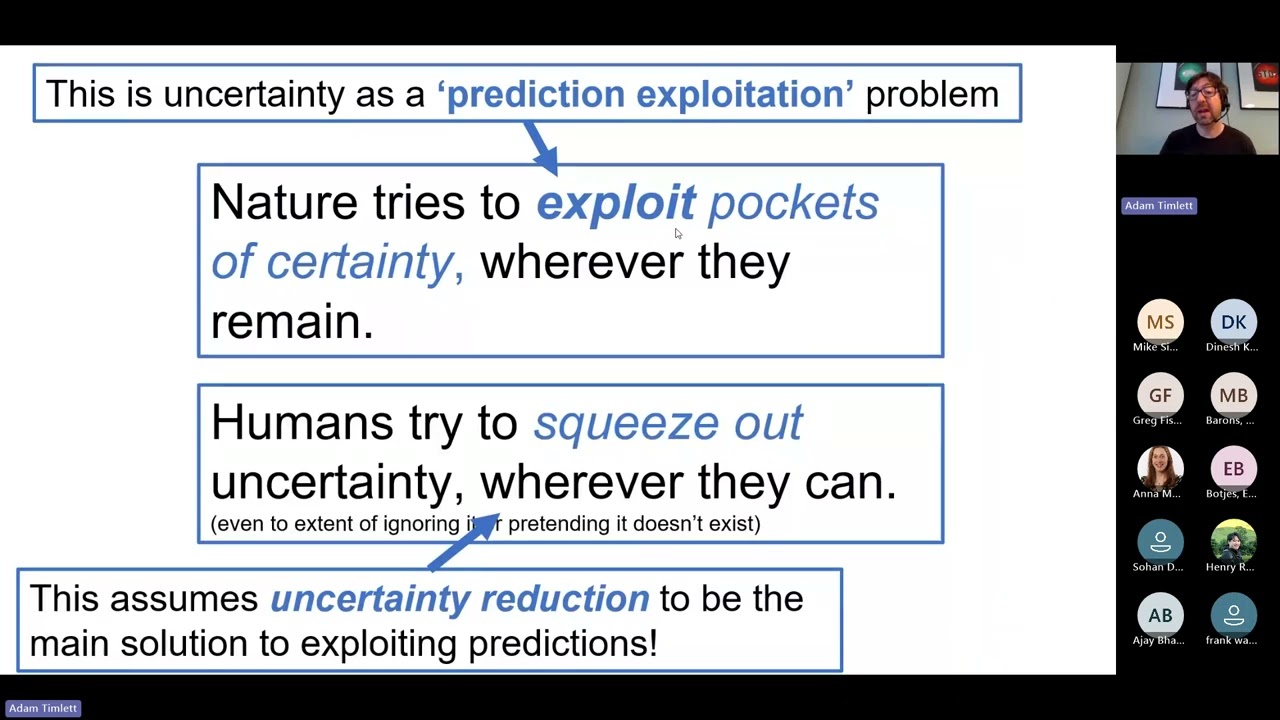
Video of On the Origin of Risk talk to DMDU
It was my pleasure to give a talk about how, in Nature, organisms cope with deep uncertainty as part of their management of their own...
Adam Timlett
Jun 1, 20251 min read


On the Origin of Risk published
'On the Origin of Risk' is available on all formats! On the Origin of Risk presents a new way of understanding the deep biases we have in the business and scientific communities in our theories of risk and the core concepts we use to manage risk, especially as organisations. It presents the evidence and argument from cutting-edge biology that risk is managed differently in organisms in Nature, and that we must learn from Nature in order to develop new theories and lead our ma
Adam Timlett
Feb 3, 20251 min read
On the Origin of Risk Book Launch Event
I'm excited to announce that PPL will be hosting the book launch of 'On the Origin of Risk' on the evening of 29th Jan. This will be...
Adam Timlett
Dec 20, 20241 min read
'On the Origin of Risk' coming in early 2025
I'm excited to announce that my new book 'On the Origin of Risk' is coming early in the 1st Quarter of 2025 with a likely release date of...
Adam Timlett
Nov 23, 20242 min read


Whitepaper: A biological definition of agility for a technology strategy knowledge graph
Context of technology strategy The investment in organisations and businesses in technology can be a significant part of the costs of...
Adam Timlett
May 19, 202310 min read


Incentivising Sustainable Complexity in Nature and in Macroeconomics
Image Credit: James Robert White Executive Summary The idea of a ‘sustainable complexity floor’ and a ‘sustainable complexity ceiling’ is...
Adam Timlett
Feb 22, 20218 min read

Ubiquinomics: A Graph-based Agent Model of Frugal Coordination
In cybernetics, Ashby's long-standing 'Law of Requisite Variety' expresses the idea that an agent must have a minimum level of internal ...
Adam Timlett
Jan 21, 20211 min read
Exchange Cybernetics: Towards a science of Agility and Adaptation
My new article on InfoQ is now live, where I develop the ideas I've been working on, offer some new practical ways of applying this...
Adam Timlett
Sep 2, 20201 min read
Simulating Agile Strategies (Video)
My presentation from aginext.io 2020 'Simulating Agile Strategies' is now online on InfoQ. In the video I explain how the simulation...
Adam Timlett
Aug 5, 20201 min read


Introduction to the Lazy Stopping Model Part II
Introduction This is Part II of the introduction to the Lazy Stopping Model, in which I explain some of the details of the theory of the...
Adam Timlett
May 25, 202026 min read
bottom of page